Have you ever cleaned the bathroom taps, only to find white marks creeping back a few days later? Or noticed that soap doesn’t lather properly, your shower glass always looks cloudy, or your freshly washed clothes feel a little stiff? These small annoyances may seem like ordinary household problems, but they can sometimes point to the quality of your water.
Water affects more than what comes out of the kitchen faucet. It moves through your plumbing, feeds your appliances, fills your shower, and plays a role in countless daily routines. When its mineral content or other characteristics cause trouble, the effects can add up over time.
Fortunately, water treatment doesn’t have to mean installing complicated equipment throughout your home. The right approach depends on what’s actually in the water, which areas are affected, and what you want to improve. Understanding those details makes it easier to choose a solution that works without spending money on features you don’t need.
What Is Hard Water, and Why Does It Matter?
Hard water contains elevated levels of dissolved minerals, mainly calcium and magnesium. These minerals occur naturally as groundwater passes through mineral-rich rock and soil. Hard water isn’t generally considered a health risk for most people, but it can create a range of practical problems around the house.
One of the most familiar signs is limescale. Those chalky deposits around faucets, showerheads, and kettles form when hardness minerals accumulate on surfaces. Inside pipes and water-heating equipment, scale can build up over time and may reduce efficiency or increase maintenance needs.
Hard water can also affect cleaning. Soap may react with minerals and leave a residue on skin, hair, fabrics, and bathroom surfaces. You might find yourself using more detergent or spending extra time scrubbing shower doors, even when your cleaning routine hasn’t changed.
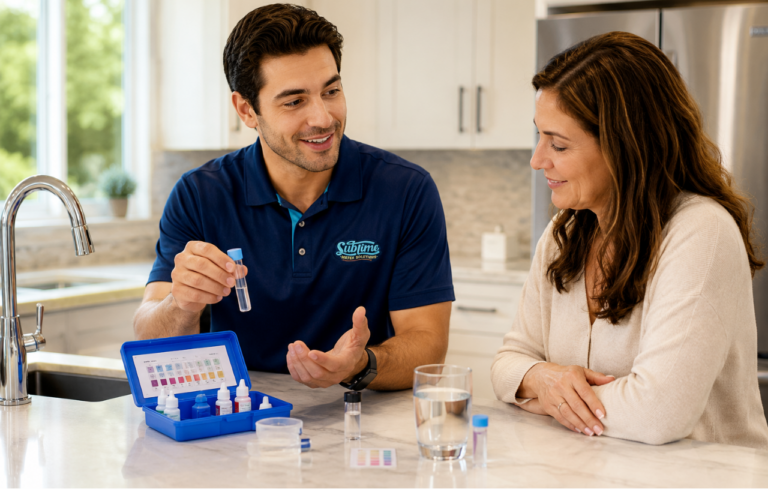
The important thing is to confirm that hardness is actually the cause. Similar symptoms can have other explanations, so a simple water hardness test is a sensible first step before buying equipment.
Finding the Right Way to Treat Hard Water
Once testing confirms that hardness is responsible for the problem, it’s time to consider suitable options. The most appropriate choice depends on the mineral concentration, household water use, available installation space, and personal preferences.
Traditional hard water treatment often involves a water softener that uses ion exchange. Inside the system, resin beads capture calcium and magnesium ions and exchange them for other ions, commonly sodium. The resin is periodically regenerated, usually with a salt solution, so it can continue working.
A conventional softener can reduce hardness throughout the plumbing system when correctly sized and installed. That may mean less scale on fixtures, easier cleaning, and better protection for certain appliances. However, the system needs regular attention, including replenishing salt and arranging maintenance when necessary.
Salt-free water conditioners are another option, although the terminology can be confusing. Some technologies alter how hardness minerals form deposits rather than removing the minerals themselves. As a result, they shouldn’t automatically be expected to provide the same results as a conventional softener.
Ask what a product actually does, how its performance is measured, and whether it suits your water conditions. Clear answers are more useful than impressive marketing claims.
Understanding Whole-Home Treatment Systems
Sometimes the concern goes beyond hardness. A household may have sediment in the water, an unpleasant chlorine taste, or a particular contaminant that requires additional treatment. In these situations, a system installed where the main water line enters the property may be worth considering.
Often called point-of-entry systems, these setups treat water before it travels to the home’s various fixtures. Depending on the equipment, they may include sediment filtration, activated carbon, water softening, or other treatment stages selected for specific water-quality concerns.
For example, a sediment filter can capture suspended particles, while activated carbon may reduce certain chemicals and improve taste or odor. A softener addresses hardness, and a suitable disinfection system can target microorganisms under the right conditions. Each component has a different job, so combining technologies should be based on actual needs.
Whole-home treatment can be convenient because the selected treatment applies to water delivered throughout the property. However, not every contaminant requires treatment at every tap. Some specialized drinking-water concerns are better addressed at a particular outlet, and a whole-house system can be unnecessarily expensive if the problem is limited.
Before installation, ask about flow rate, filter capacity, maintenance costs, and how the equipment may affect water pressure. A system should be able to meet your household’s demand, including those busy mornings when showers, laundry, and kitchen taps are all in use.
When a Drinking-Water Filter Makes More Sense
Imagine that your shower water is comfortable, your appliances are working well, and your main concern is simply the taste of water used for drinking and cooking. In that case, installing a large treatment system throughout the house might not be the most practical choice.
Point-of-use systems treat water at or near the place where it’s used. Common examples include under-sink filters, countertop units, and reverse osmosis systems installed for a kitchen tap. Some refrigerator filters also fall into this category.
These systems can be useful when testing identifies a contaminant that a specific filter is certified to reduce. Activated carbon, for instance, can improve certain taste and odor problems, while reverse osmosis can reduce a range of dissolved substances when the equipment is designed for that purpose.
Still, no filter removes everything. Check the manufacturer’s performance claims and look for independent certification relevant to the contaminant you’re trying to address. A filter marketed for better taste shouldn’t be assumed to make microbiologically unsafe water safe to drink.
Maintenance matters here, too. Filters have limited capacity, and replacement intervals vary according to the model, water quality, and usage. A neglected filter may perform less effectively than expected, so keep track of when it needs changing.
Start With Water Testing, Not Guesswork
Water testing helps turn a vague concern into a more specific plan. If the issue is hardness, a hardness test may be enough to guide the next step. If you suspect contamination, the testing needs to be more comprehensive and tailored to your water source.
Homes supplied by municipal water and homes using private wells can have different needs. Municipal suppliers generally treat water before distribution, but household plumbing can influence water quality. Private well owners are responsible for arranging appropriate testing and should follow local health recommendations for bacteria, nitrates, and other potential contaminants.
A qualified laboratory or water treatment professional can help determine which tests make sense. Once you have the results, compare treatment options based on what they remove, their operating costs, and the maintenance involved.
Be cautious if a salesperson recommends expensive equipment without first asking about your water or explaining the reason for the recommendation. A reliable provider should be able to connect the proposed treatment to an identified issue and discuss its limitations honestly.
Don’t Forget About Maintenance
Even good equipment needs care. Filters become exhausted, softeners need salt or servicing, and some systems require periodic checks to confirm that they continue to operate properly.
Create a simple maintenance schedule and keep copies of your water test results. If the taste, odor, or appearance of your water changes noticeably, investigate rather than assuming the treatment system is still doing its job. After repairs or changes to a private well, additional testing may also be appropriate.
Regular maintenance isn’t the most exciting part of owning a home, admittedly. But it’s often less expensive and less stressful than waiting until equipment stops working or a water-quality problem returns.
Making a Practical Choice for Your Home
Better water starts with understanding what needs to change. Hardness, taste, sediment, and specific contaminants are different concerns, and they don’t all respond to the same treatment method.
Take time to test the water, compare suitable technologies, and consider how much maintenance you’re comfortable handling. A whole-home system may be useful when several water-quality issues affect the property, while a filter at one tap may be perfectly adequate for a more limited concern.
The best solution isn’t necessarily the largest or most expensive one. It’s the system that addresses your actual needs, fits your budget, and can be maintained properly over the years. With a little research and sensible planning, you can spend less time dealing with stubborn deposits and water-related frustrations—and more time enjoying the comfort of a home that works the way it should.